
Custom solid desiccants combine moisture protection with a shape that fits your equipment. Explore pressed ADV components and injection moulded IMD parts below, or contact our technical team to discuss your application.
Pressed Desiccants ADVInjection Moulded Desiccants IMD
Pressed Desiccants ADV
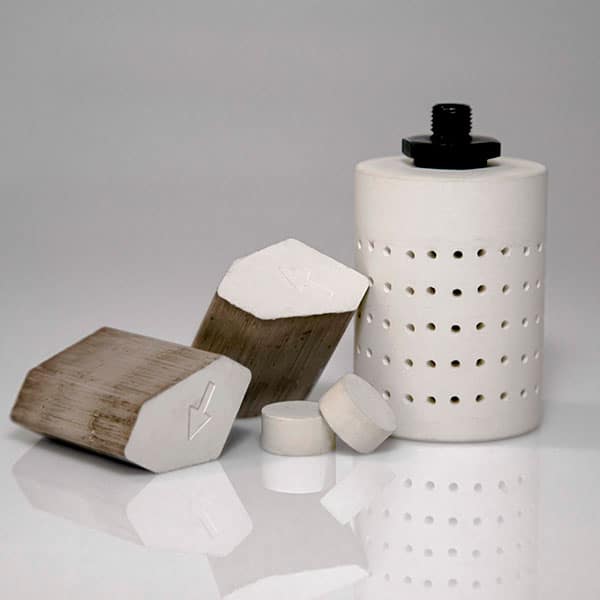
Arcadia ADV is a pressed composite of molecular sieve and heat-resistant binders. It combines moisture adsorption, compressive strength and thermal resistance in a solid component that can be moulded or machined to suit the available space.
Standard shapes
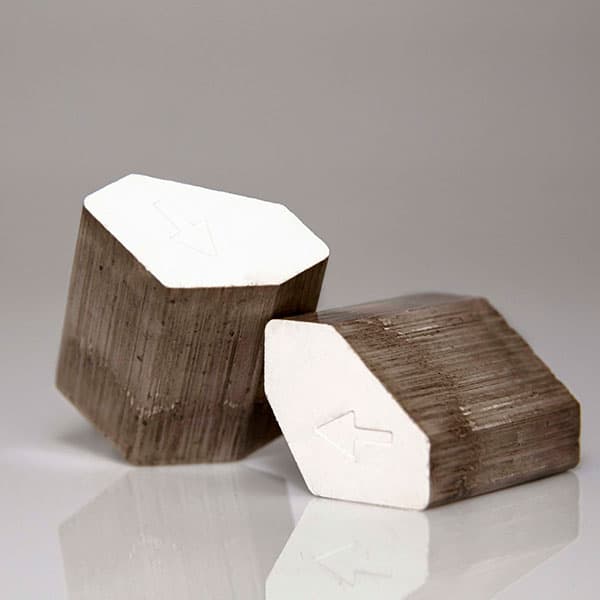
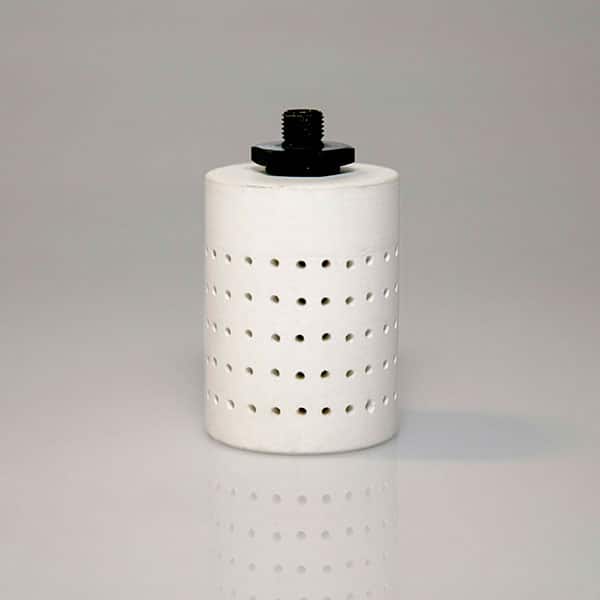
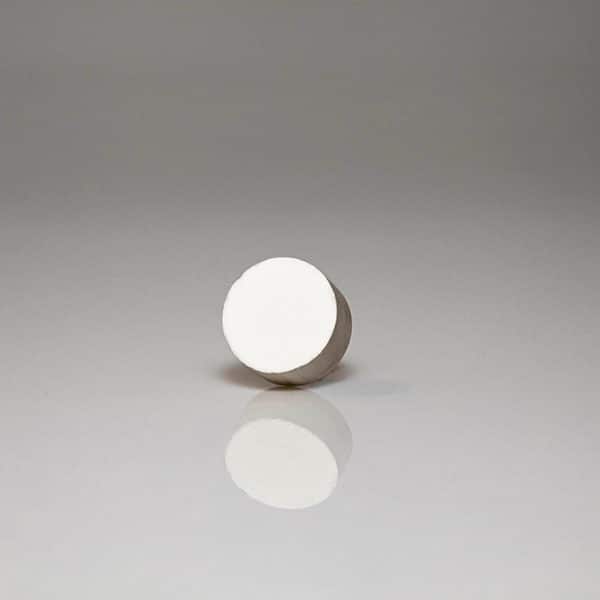
The following standard shapes are available for evaluation alongside custom sizes. Please contact our technical team to discuss samples and availability.
| Arcadia part number | Nominal dimensions (inches) | Shape |
|---|---|---|
| PSD2073 | 2″ diameter × 1″ tall | Puck |
| PSD2076 | 2.75″ long × 1.10″ wide × 0.75″ tall | Block |
| PSD2071 | 2.75″ long × 1.10″ wide × 1.00″ tall | Block |
| PSD2070 | 0.34″ diameter × 0.20″ tall | Tablet |
| PSD2077 | Ø3.25″ × 0.75″ | Puck |
| PSD2078 | 2″ diameter × 2″ tall | Cylinder |
| PSD2079 | 4.0″ long × 2.0″ wide × 1.5″ tall | Block |
Material and performance
ADV can provide structural support as well as moisture control, helping replace separate plastic or metal parts, insulators and shock pads. The material is available in custom shapes and desiccant pucks, for both small and large production quantities, and can replace similar pressed-desiccant products.
| Property | Value |
|---|---|
| Desiccant | molecular sieve with heat-resistant binders |
| Compressive strength | 6,000 psi |
| Maximum continuous service temperature | 150°C (302°F) |
| Maximum short-duration service temperature | 350°C (662°F) |
| Moisture capacity at 25°C (77°F), 50% RH | Up to 2.9 g water per in³ |
Adsorption rate
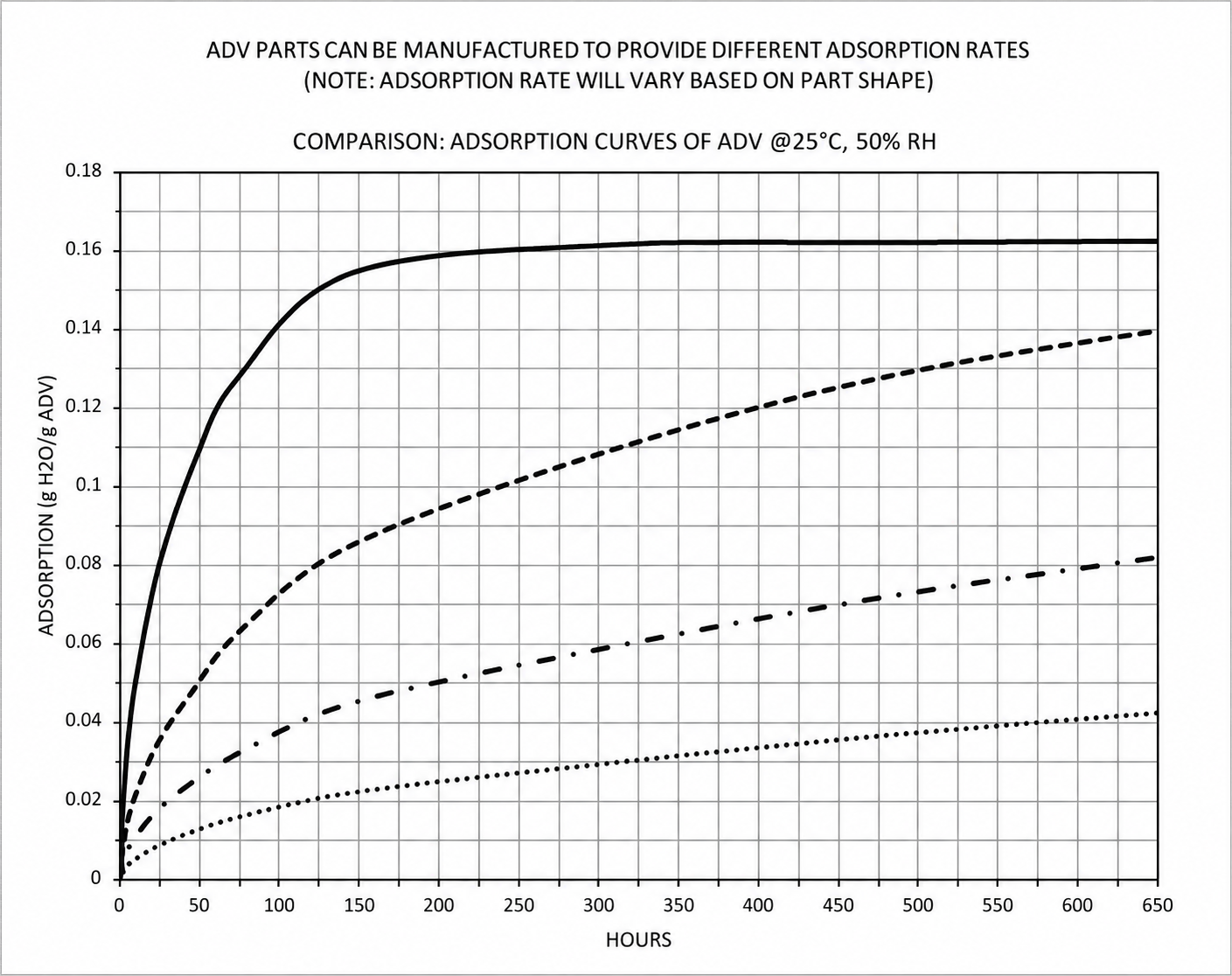
Part shape and manufacture affect adsorption rate. The comparison below shows different ADV adsorption curves at 25°C and 50% relative humidity.
Custom shapes and installation
ADV is suited to restricted spaces and complex geometries. Compared by volume, it offers greater adsorption capacity than traditional bagged desiccant or molecular sieve beads held in a container. Its solid form can be secured with screws, bolts, epoxy or a combination of these methods; it may also be mounted to a circuit board or held in a dedicated enclosure holder.
Pressed blanks have a cylindrical or prism form with two parallel faces. Before subsequent machining, the blank must fit within a 4.5 in diameter cylinder and be no taller than 2 in. Machining can then produce more complex shapes to suit the design.
Non-dusting performance
ADV exceeds the Type II desiccant dusting requirements of MIL-D-3464E, making it suitable for moisture control in electronics and other applications where loose dust is undesirable.
Regeneration
ADV may be regenerated using a vacuum oven, roughing pump, vacuum pump and an airtight container. Obtain the correct regeneration temperature and vacuum settings from our technical team before starting; the process varies by desiccant type.
- Place the components in the heated oven and establish the specified vacuum.
- Heat for at least 24 hours, then remove and weigh a sample and record its mass.
- Return the sample to the oven for a further 6 hours and weigh it again.
- If mass decreases by more than 0.1%, continue with further 6-hour heating and weighing cycles. A decrease below 0.1% indicates regeneration; consult our technical team for a borderline result.
- Transfer the regenerated components into an airtight container and allow them to cool to room temperature.
Contact our technical team for detailed regeneration instructions and product specification or safety information.
Applications
They are clean, flexible, high-capacity adsorbing products and are ideally suited to the below applications.
- Airborne Sensors
- Electronics
- Packaging
- Medical Devices
- Circuit Boards
- Semiconductors
- Photovoltaics
- Optical Lens
- Pharmaceutical
- Digital displays
Contact our technical team for further information on these products.
Injection Moulded Desiccants IMD
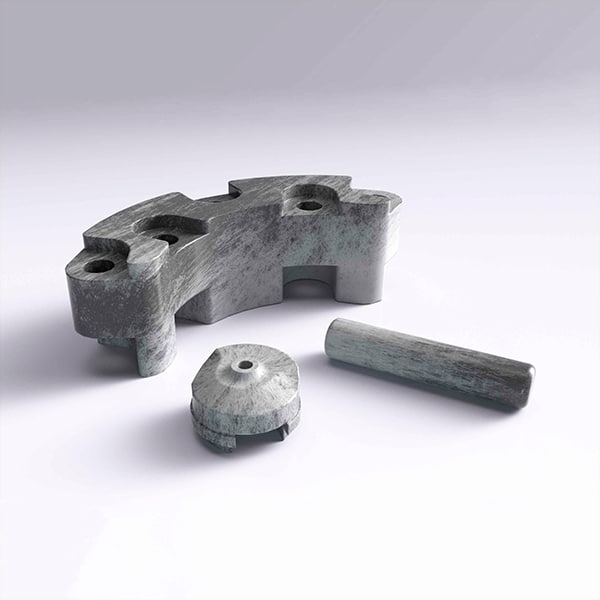
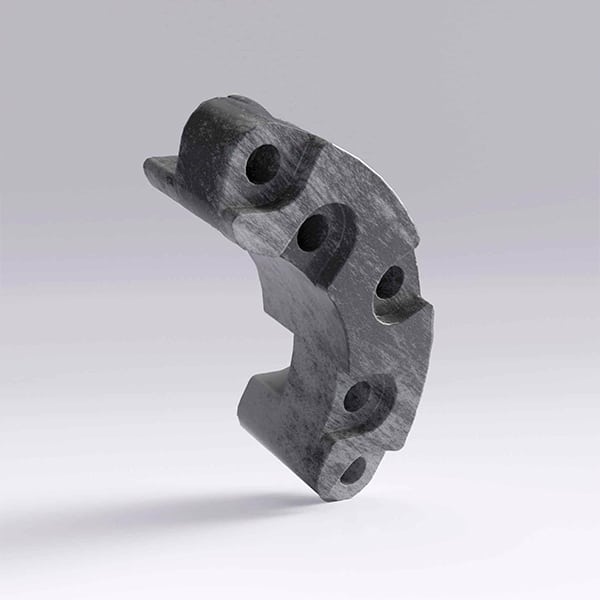
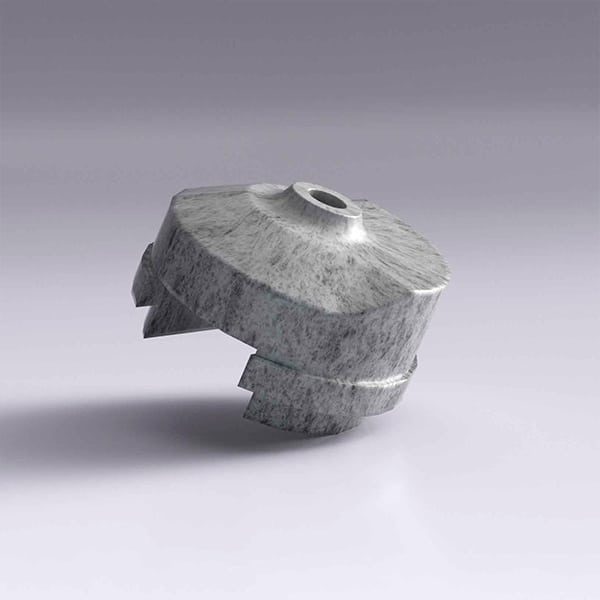
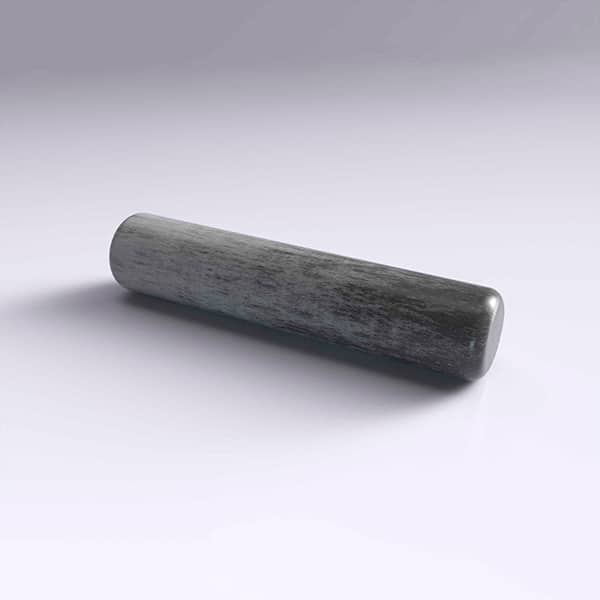
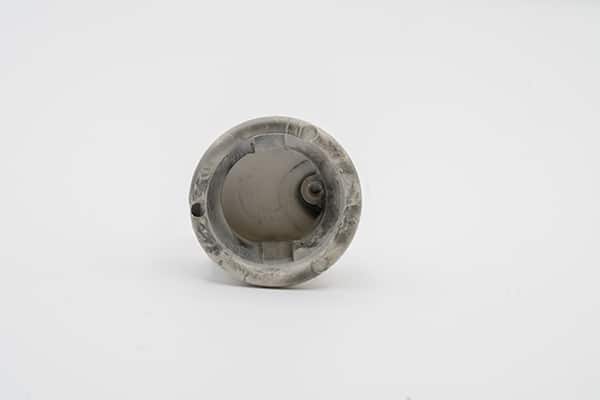
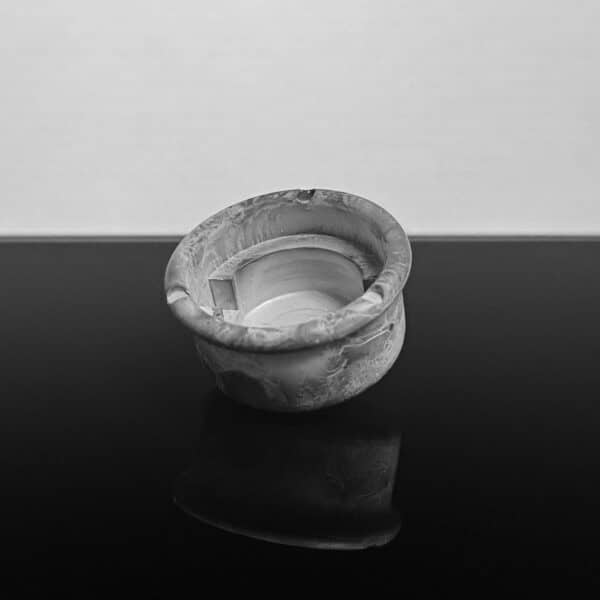
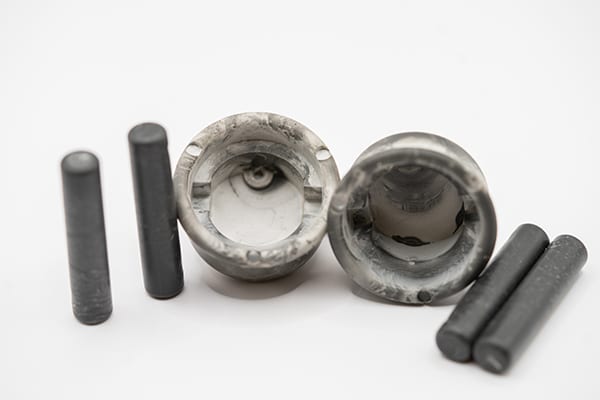
Arcadia IMD combines molecular sieve, a nylon binder and proprietary additives to form strong, moisture-adsorbing components. Injection moulding allows the material to follow customer requirements for shape, size and thickness, including small parts and complex geometries.
Material and performance
IMD combines adsorption capacity with crush strength and the ability to serve as a structural component. The molecular sieve remains effective at very low humidity, while naturally hygroscopic nylon contributes to moisture uptake and provides strength. Custom moulded parts can also replace similar solid-desiccant components.
| Property | Value |
|---|---|
| Nominal dry density | 1.31 g/cm³ |
| Compressive strength | 6,000 psi |
| Flexural strength | 2,000 psi |
| Functional moisture capacity | 2.50 g/in³ |
| Maximum continuous service temperature | 120°C |
| Maximum short-duration service temperature | 200°C |
Adsorption rate
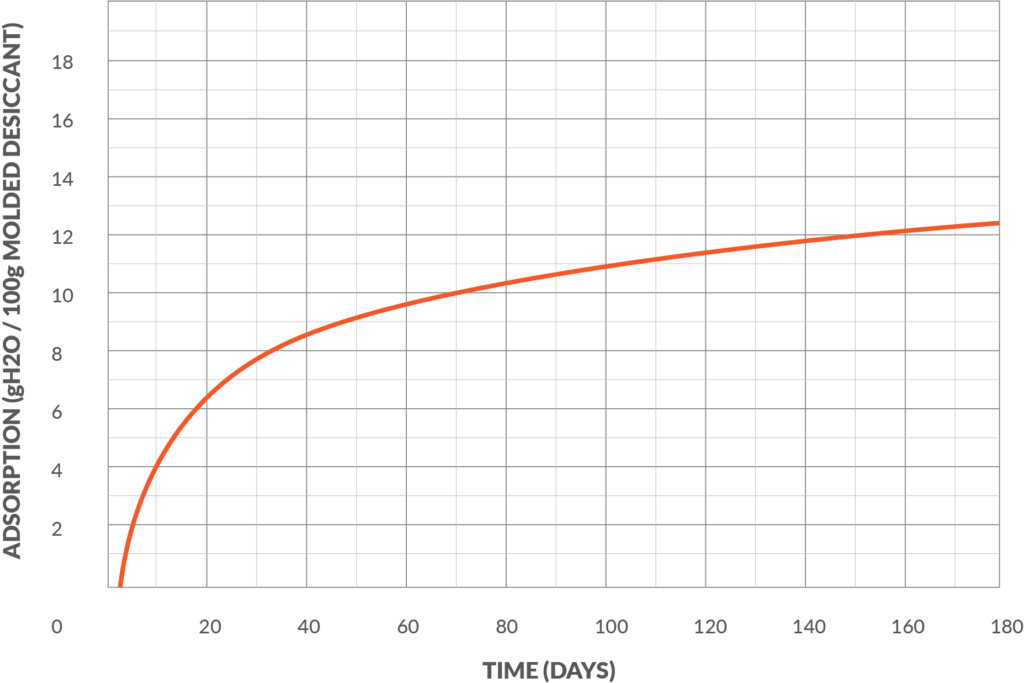
Adsorption rate is affected by part geometry. The graph below shows moisture adsorption over time for moulded desiccant.
Non-dusting performance
IMD exceeds the Type II dusting requirements in MIL-D-3464E and is suitable for electronics and other moisture-sensitive installations requiring a non-dusting solid desiccant.
Rapid prototyping
Prototype parts can be produced using 3D-printed moulds and benchtop injection moulding equipment. This provides samples for application development, material evaluation and preliminary fit-and-form checks before committing to production tooling.
Prototype moulds do not provide the dimensional tolerances or part-to-part repeatability of production injection moulding tooling. Typical capabilities and restrictions are:
- Maximum shot volume: 25 cm³ (1.5 in³), approximately the volume of a 1.15 in cube.
- Maximum mouldable cross-section: approximately 2.35 in × 2.35 in.
- Maximum part depth: approximately 1.50 in.
- Geometry must suit a simple straight-pull mould. Slides, side actions and features requiring lateral mould movement are not supported.
- Small sample runs, generally in the tens of parts, with minimum practical quantities preferred.
Contact our technical team with your part geometry, application and sample requirements to assess suitability for IMD rapid prototyping, and to request product specification or safety information.
Applications
They are clean, flexible, high-capacity adsorbing products and are ideally suited to the below applications.
- Airborne Sensors
- Electronics
- Packaging
- Medical Devices
- Circuit Boards
- Semiconductors
- Photovoltaics
- Optical Lens
- Pharmaceutical
- Digital displays
Contact our technical team for further information on these products.
